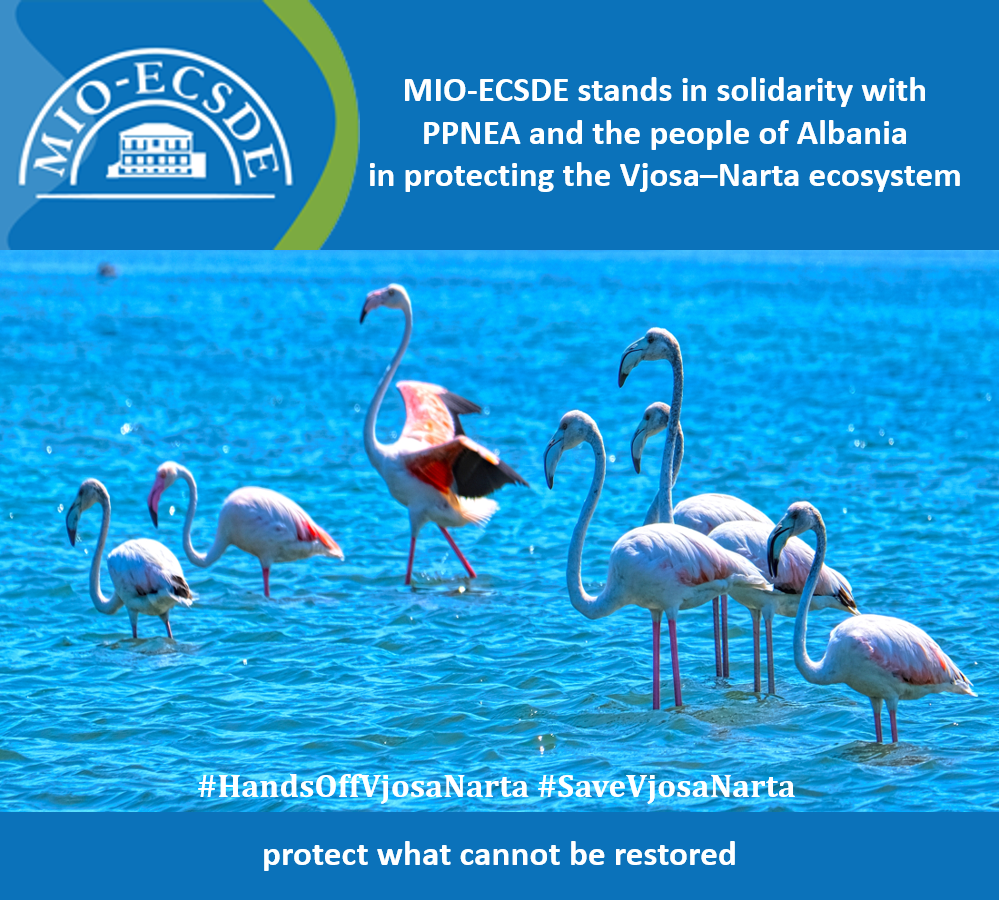
 The Vjosa–Narta Protected Landscape is one of Europe’s most extraordinary coastal ecosystems, a mosaic of lagoons, wetlands, and shallow waters of exceptional ecological importance.
It shelters over 70 endangered species and more than 200 bird species, including flamingos and Dalmatian pelicans. It lies on the Adriatic Flyway—one of the world’s most important migration corridors—through which millions of birds travel each year between Africa and Europe. Its surrounding marine and coastal waters are among the last Mediterranean refuges for the endangered Mediterranean monk seal and serve as a key nesting ground for the loggerhead sea turtle.
Designated as a Protected Landscape in 2004 and further strengthened under Albania’s 2017 Law on Protected Areas, the site is recognised for its high biodiversity value, its critical importance for migratory birds, and its outstanding landscape and ecological significance, representing a natural heritage of both national and global importance.
Law No. 21/2024 introduced amendments to Albania’s Protected Areas framework, allowing certain tourism-related developments within protected area categories, including protected landscapes, and increasing flexibility in zoning and permitted land uses. Environmental organisations have expressed concern that these changes may weaken established conservation safeguards in ecologically sensitive areas such as Vjosa–Narta.
Following these legislative changes, major tourism projects were announced for the Vjosa–Narta region and surrounding areas, and preparatory and construction works have reportedly already begun in parts of the area. This has triggered serious concerns among environmental organisations, scientists, and citizens about the future of this fragile ecosystem, with MIO-ECSDE’s member PPNEA warning that the scale of destruction would be unprecedented if these works are completed.
We therefore stand in solidarity with PPNEA and the people of Albania in protecting the Vjosa–Narta ecosystem, and in line with the Aarhus Convention on access to information, public participation in decision-making, and access to justice in environmental matters, join PPNEA in calling for:
- Full and proactive disclosure of environmental information, including all development plans, permits, contracts, environmental studies, and agreements related to current and proposed projects in the Vjosa–Narta Protected Landscape.
- Immediate publication of all scientific, ecological, and technical assessments that informed the 2024 legislative amendments and any subsequent planning or permitting decisions.
- Effective and meaningful public participation in all decision-making processes affecting the Vjosa–Narta ecosystem, ensuring timely consultation with local communities, scientists, and civil society in accordance with Aarhus Convention requirements.
- Access to justice and review procedures, ensuring that all relevant decisions, permits, and assessments are subject to independent legal and administrative scrutiny where environmental obligations may not have been fully respected.
- Application of the precautionary principle, including suspension of activities in ecologically sensitive areas where significant environmental impacts are uncertain or not yet adequately assessed.
- Protection of the ecological integrity of the Vjosa–Narta ecosystem, including its wetlands, lagoons, and migratory bird habitats, as a matter of compliance with applicable EU and international biodiversity commitments.
This is not a call against investment or tourism. It is a call for transparency, scientific integrity, and full respect for environmental law and biodiversity commitments in decisions affecting protected areas. Sustainable development and nature conservation must go hand in hand. Decisions affecting protected areas must be guided by science, caution, and responsibility toward future generations.
💚 MIO-ECSDE stands with PPNEA and the people of Albania in defending the Vjosa–Narta Protected Landscape.
👉 We urge everyone to support PPNEA’s petition addressed to the Government of Albania, the European Commission, the European Parliament, and international environmental organisations, to sign it, and to share it widely.
Some landscapes, once lost, cannot be restored—they are lost not only to Albania, but to all of us, and to generations yet to come.
#HandsOffVjosaNarta #SaveVjosaNarta
Read this in French here