
The SOS-ZEROPOL2030 project has published three new deliverables that help turn Europe’s Zero Pollution ambition into practice. MIO-ECSDE led the development of all three outputs, which combine a strategic implementation roadmap with pollutant-specific guidance to help policymakers, environmental managers, researchers and other stakeholders address some of the most pressing pollution challenges affecting Europe’s aquatic ecosystems.
The Zero Pollution Roadmap
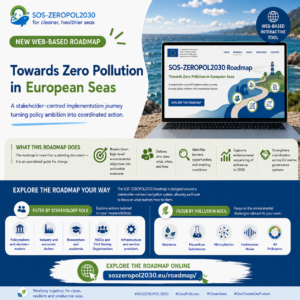
The Zero Pollution Roadmap is an interactive decision-support tool that provides an operational implementation framework for addressing four major pollution pressures affecting Europe’s aquatic ecosystems—chemical contamination, nutrient pollution, underwater noise and microplastics. By linking environmental objectives with concrete actions, implementation pathways, responsibilities and indicative timeframes through to 2050, the Roadmap helps users understand what needs to be done, who should act and when. It provides policymakers and other stakeholders with a practical framework for implementing the EU Zero Pollution Action Plan and accelerating the transition towards zero pollution in Europe’s seas.
Specific Guidance for PFAS and TWPs
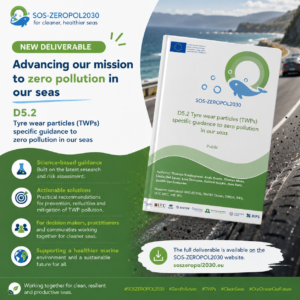
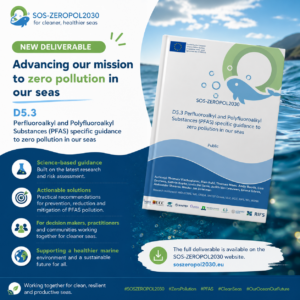
Complementing the Roadmap, the project has also developed two pollutant-specific guidance documents focusing on per- and polyfluoroalkyl substances (PFAS) and Tyre Wear Particles (TWPs). Although these pollutants present distinct environmental and governance challenges, the guidance documents demonstrate how zero pollution approaches can be adapted to pollutants with different characteristics, emission pathways and levels of scientific understanding.
The guidance adopts a source-to-sea and lifecycle perspective, highlighting the importance of preventing pollution at source while supporting coordinated action across production, use, release pathways and end-of-life management. For PFAS, it emphasises precautionary approaches, substitution, improved monitoring and emission control to address these persistent “forever chemicals”. For TWPs, it outlines measures ranging from improved tyre design and sustainable mobility to infrastructure solutions and particle capture that reduce the release of this emerging source of microplastic pollution. Together, the two guidance documents provide practical recommendations for tackling both persistent chemical pollution and emerging sources of microplastics, supporting more effective implementation of zero pollution approaches across Europe’s aquatic environments.
The deliverables are available on the SOS-ZEROPOL2030 project website:
Read this French here