Two new reports from the SHARED GREEN DEAL project have been released, showcasing how community-driven initiatives across Europe can significantly contribute to the EU’s climate action and zero-pollution agenda. The reports draw on evidence from 24 social experiments, in which MIO-ECSDE played an active role. Haris Paliogiannis of MIO-ECSDE is among the main authors.
The findings demonstrate that local participation can meaningfully advance environmental goals, even when community activities target themes not explicitly directly framed as climate or pollution-related. By using participatory methodologies, the experiments helped translate broad European Green Deal priorities into practical, context-appropriate local action.
Importantly, many of the environmental benefits identified in the reports emerged as co-benefits of initiatives driven by everyday concerns, comfort, affordability, well-being and health, rather than traditional environmental messaging. This reinforces the need to connect policy goals to people’s lived experiences.
However, the reports also highlight several barriers limiting the wider uptake and impact of such initiatives. Insufficient institutional support, fragmented policy frameworks, and short-term funding often constrain the ability of smaller or community-level actors to scale their efforts or influence public decision-making. Additionally, vulnerable groups, including low-income households and rural communities, face structural inequalities that hinder full participation in, or benefit from, climate and pollution-reduction actions.
To overcome these obstacles, the reports put forward recommendations across governance levels:
- At the local level: stronger support for participatory planning, education, and community-based resources—such as renovation hubs, neighbourhood food initiatives, or youth-led sustainable mobility activities.
- At regional and national levels: efforts to streamline policy frameworks, reduce administrative complexity, and adapt funding and monitoring systems so that community action is properly recognized for its various benefits.
- At EU and international levels: long-term investment in transdisciplinary approaches that integrate technological advancements with community empowerment, as well as platforms for cross-country learning and improved data systems capturing local contributions.
Overall, the findings underline that community-based action has a critical role to play in our pathways toward climate neutrality and a pollution-free environment—provided it is supported by coherent, multi-level governance and sustained institutional commitment.
The full reports are available here:
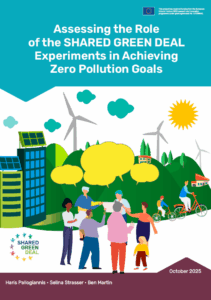
- Assessing the Role of the SHARED GREEN DEAL Experiments in Achieving Zero Pollution Goals
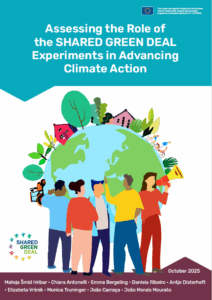
- Assessing the Role of the SHARED GREEN DEAL Experiments in Advancing Climate Action
Read in French here.